Two brothers, a cabinet, a few good books.
The photograph is from 1982, a year I know only because someone wrote it on the back in blue ballpoint, the ink gone the soft grey of a pencil nobody keeps sharp anymore. A mother and a father, two sons. Film from that decade goes warm the way skin goes warm from sun, and by now the whole rectangle has drifted toward the color of weak tea. Nobody in it is posing. Someone off to the side had just said a name, and every head in the room turned half a second too late for the shutter, so the picture is really a picture of four people arriving at attention rather than four people already there.
My father is wearing a shirt with small stars printed on it, the kind of shirt a grown man forgets by lunchtime and a boy remembers for forty years, mostly because he was the boy small enough to be carried in it. My brother is nine, maybe ten, and he is standing the way an older brother stands next to a younger one: not touching, exactly, but placed so that nothing could reach me without going through him first. He does this in every photograph from that year. Nobody taught him the position. He does not know, even now, that he is still holding it.
Cavite City sits on a narrow spit of land that pushes into Manila Bay like a hand held up to shade the eyes, and if you grew up there you grew up facing water that led somewhere else. Our family has been on this peninsula long enough that the crossing that first brought us here belongs to an ancestor none of us met, a name kept now mostly by a place rather than by memory. What survives instead is smaller, and more useless in the way that actually matters: a shirt, a gesture, the particular slant of afternoon light through a window that has since been replaced twice.
I did not think of any of this as inheritance until I was much older, sitting across a table from my brother, both of us grown, trying to explain to each other what a business we might start together would actually be about. Not what it would sell. What it would be about.
He had spent a decade by then mixing and packaging scent for other people's labels, small-batch orders, his name on nothing that shipped. I had spent that same decade writing things nobody paid me for. Neither of us was a person you would bet money on to start a company. We had, between the two of us, exactly one asset worth anything: a nose that had learned what a fragrance is actually built from, and a stubborn habit of writing down what things smelled like, felt like, meant, long after anyone had asked.
The photograph was on the table between us that evening, next to the coffee, because our mother had been going through boxes again and had set this one aside without saying why. Neither of us picked it up right away. We just kept talking around it, the way you talk around the one thing that has already settled the question before either person says so out loud.
A family is not the photograph, I said eventually, mostly to hear whether it sounded true. A family is the cabinet it gets kept in.
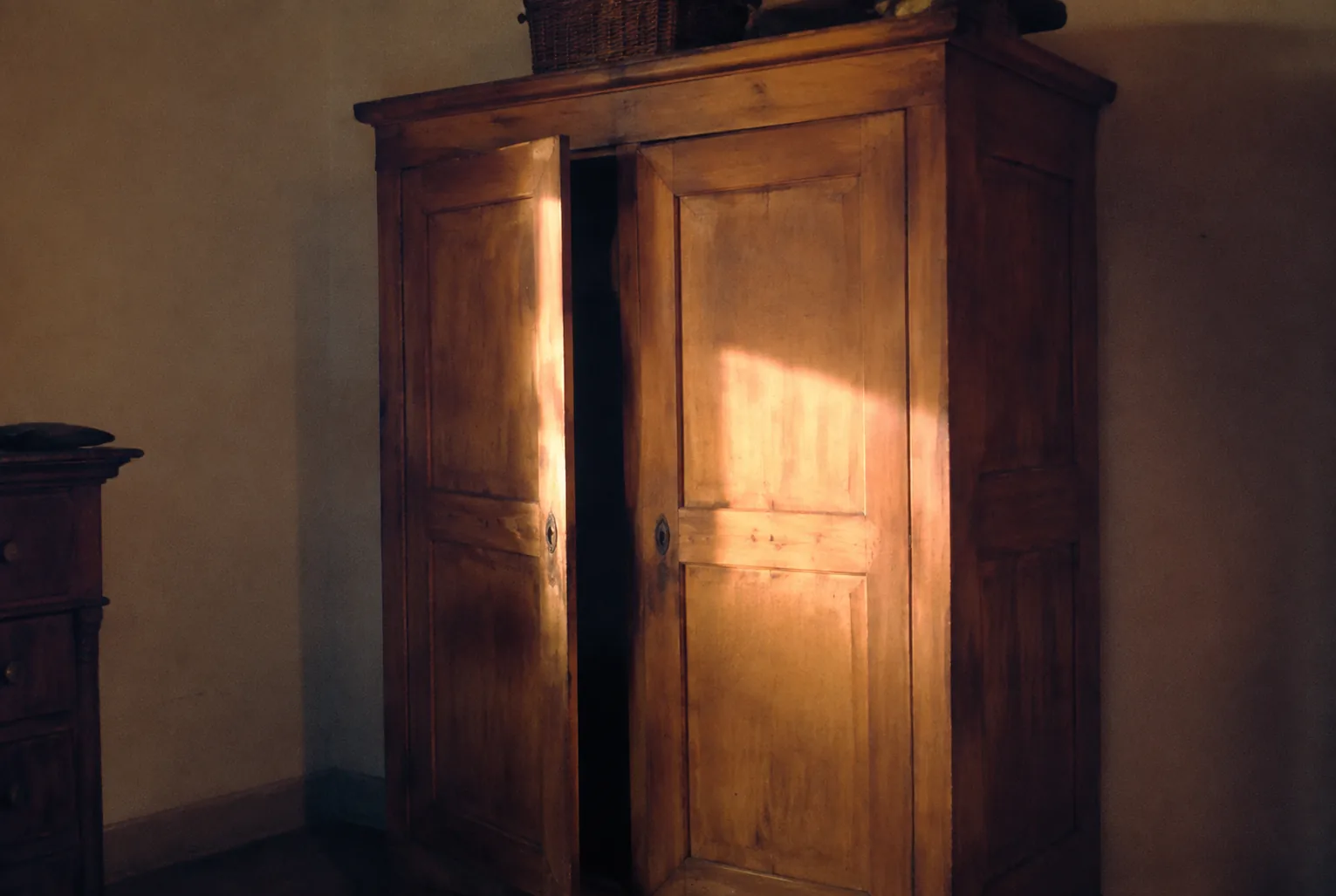
Almario is the Filipino word, by way of the Spanish armario, for that cabinet — the tall wooden one with doors that never quite close flush, the one every house on this peninsula seems to have inherited rather than bought. We are not precious about the etymology. We are precious about the job the thing does: it holds what a household doesn't use every day and could not stand to lose. A good coat. A letter. A smell that got attached, permanently and a little unfairly, to one particular Sunday, and has refused to let go of it since.
We do not blend the fragrances ourselves. We say this plainly, because it is true, and because the one dishonesty a project like this cannot afford is implying a laboratory that doesn't exist. What we do is choose, and name, and write down what a scent leaves behind — the same instinct that had one of us bent over sample vials for a decade and the other bent over a notebook for that same decade. A label goes on: the Manifest, all monospace and lot numbers, or the Bookplate, quieter, centered, built for a gift rather than a feed. A bottle goes out, addressed to whoever ordered it, carrying a name the way the cabinet carries ours.
The shirt with the small stars printed on it does not exist anymore, as far as either of us knows. It was the kind of shirt that gets given away, or worn to rags, or simply outlived by the people who loved it, the way most ordinary, cherished things are outlived. What's left is the photograph, going warmer every year, and the cabinet it eventually got put into, and now this: six bottles, six books, a website instead of a storefront, and two brothers still standing, in effect, at that same table — not quite touching, positioned so that nothing important gets past one of us without going through the other first.
— cavite · 2026